
- Bring your own drinks
- Alcoholic and non-alcoholic drinks provided
-

- Cats live here
-
Wheelchair access
- Not wheelchair accessible
-

- Some stairs may be present in the space

This is a groupmuse
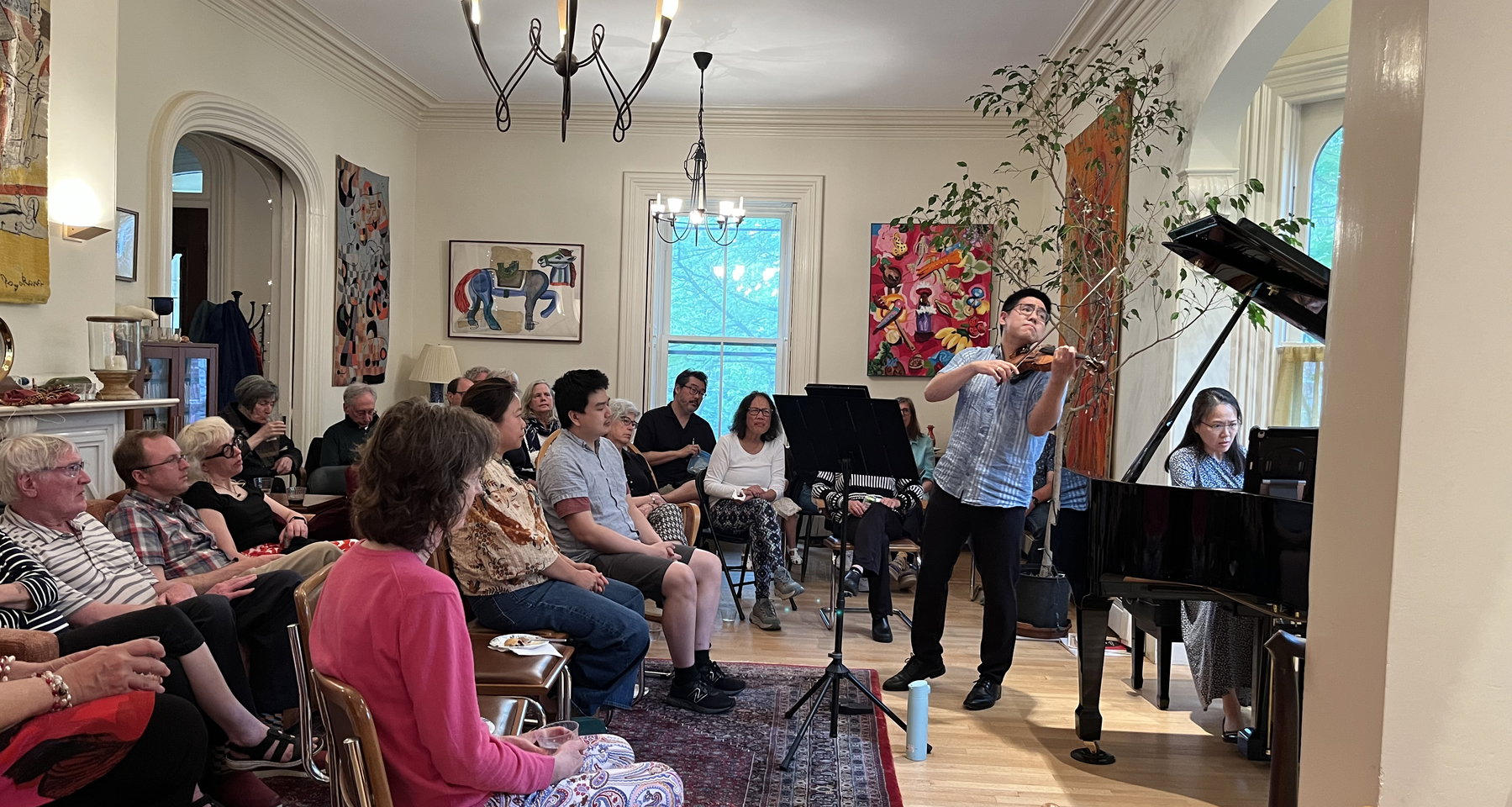
A live concert in a living room, backyard, or another intimate space. They're casual and friendly, hosted by community members.
Host

Please join us on a spring evening for two piano quintets - Brahms and Shostakovich - courtesy of old musical friends Tim Paek and Kiyoshi Hayashi and colleagues, Jesse MacDonald, Samuel Kelder, and Yundu Wang.
What's the music?


Piano Quintet in G minor, Op. 57 (1940)
Dmitri Shostakovich (1906–1975)
I. Prelude: Lento — Allegretto
II. Fugue: Lento
III. Scherzo: Allegretto / Intermezzo
IV. Intermezzo: Lento
V. Finale: Allegretto
Piano Quintet in F minor, Op. 34 (1861–64, rev. 1865)
Johannes Brahms (1833-1897)
I. Allegro non troppo
II. Andante, un poco adagio
III. Scherzo: Allegro
IV. Finale: Poco sostenuto — Allegro non troppo
Where does this music come from?
Dmitri Shostakovich’s Piano Quintet is dedicated to the Beethoven Quartet and Lev Oborin, Shostakovich’s Piano Quintet was composed in 1940 and quickly became one of his most popular chamber works, earning the Stalin Prize. The quintet is compact and tightly constructed, combining biting irony, intimate lyricism, and sudden emotional shifts. Scored for piano and string quartet, it juxtaposes the piano’s percussive clarity with the strings’ sustained lines to create sharp dialogues and concentrated drama.
1940 found Dmitri Shostakovich teaching composition at the Leningrad Conservatory, with the Soviet Union on the cusp of war with Germany. He was enjoying regained favor from Russia’s critics and public after the success of his Fifth and Sixth Symphonies and First String Quartet. He wrote the latter in 1938 for the Glazunov Quartet in Leningrad (during a bout of personal interest in chamber music), and while working on it the Glazunov players proposed the idea of his writing a piano quintet – specifically so he could perform with them. “I’ll write a quintet immediately,” he said, “and I’ll definitely play it with you.”
Johannes Brahm’s Piano Quintet, originally conceived in several earlier forms for string quintet as well as two pianos, was finalized in 1865 as the piano quintet we know today, Brahms’s F minor Quintet is a masterpiece of Romantic chamber music. It fuses Classical formal rigor with dense, symphonic textures and powerful emotional intensity. piano assumes an orchestral role alongside the strings, and Brahms’s mastery of counterpoint and motivic transformation drives the work’s concentrated drama.
The second transformation came about on the advice of Hermann Levi to form a piano quintet out of the ashes of the sonata. Brahms complied by sending the newest manifestation of the score to Levi, who responded on November 5, 1865, “The Quintet is beautiful beyond words. Anyone who did not know it in its earlier forms of string quintet and two-piano sonata would never believe that it was not originally thought out and designed for the present combination of instruments… You have turned a monotonous work for two pianos into a thing of great beauty, a masterpiece of chamber music…”
Location
Exact address sent to approved attendees via email.
This is a groupmuse
A live concert in a living room, backyard, or another intimate space. They're casual and friendly, hosted by community members.
Host
Attendees














 Continue with Facebook
 Continue with Google
 Continue with Apple
Comments
Comment sections are only for participants.