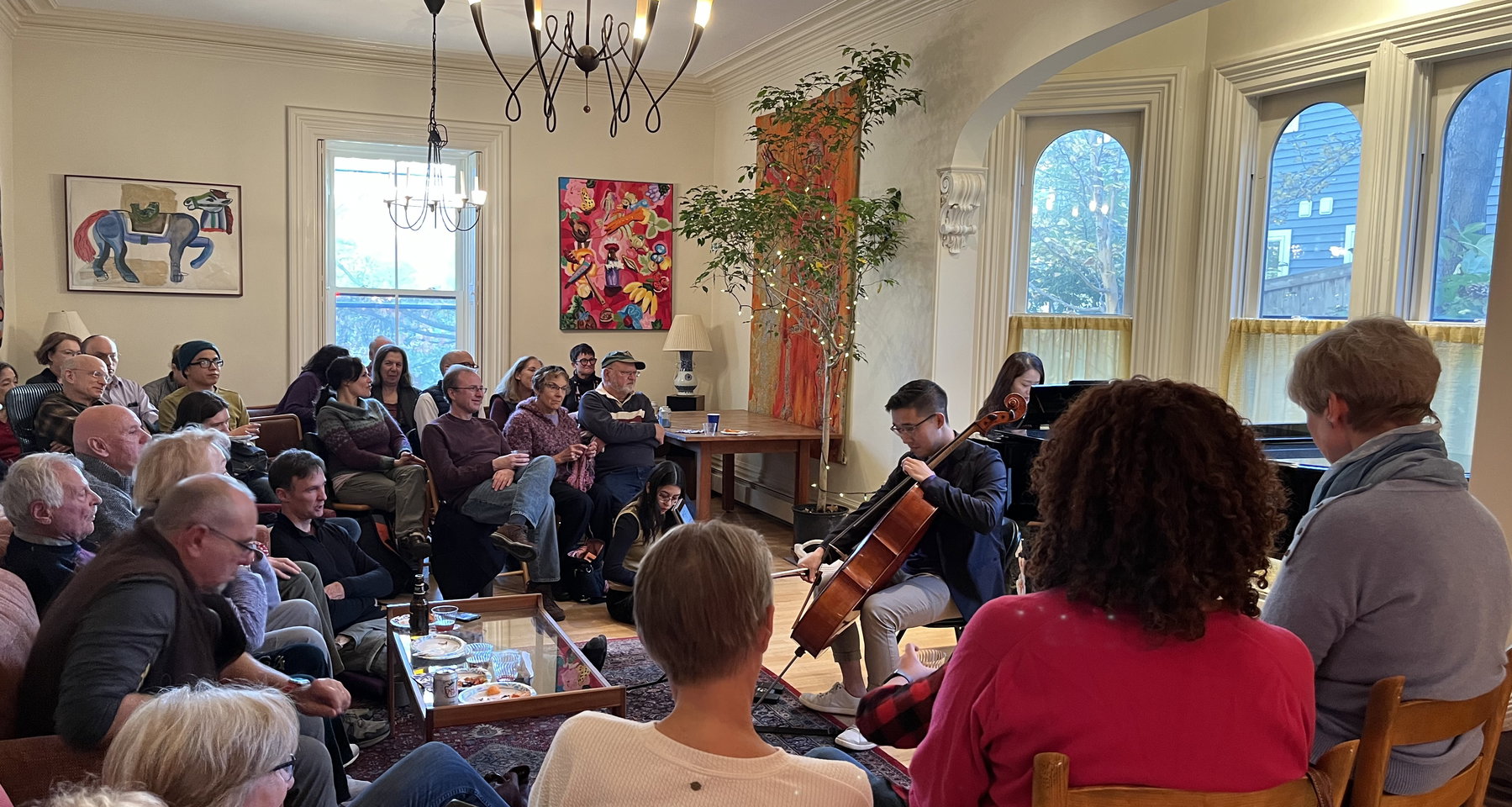
Wind and strings with Cape Cod Chamber Players
Jamaica Plain, Boston
Thu, November 19, at 6:30 PM, EST

- Bring your own drinks
- Alcoholic and non-alcoholic drinks provided
-

-
Not designed for kids
This event's geared toward adults, please leave little ones at home.
-

- Cats live here
-
Wheelchair access
- Not wheelchair accessible
-

- Some stairs may be present in the space

This is a groupmuse
A live concert in a living room, backyard, or another intimate space. They're casual and friendly, hosted by community members.
Host

We are thrilled to welcome back Tim Paek and Jesse MacDonald and some of his Cape Cod Chamber Orchestra players, for an evening of quartets and quintets featuring oboe, cello, violin, and viola. Please join us!
What's the music?


Beatles | String Quartet Set
Edward Elgar (1857–1934)
Andante sostenuto and Allegro for Oboe Quartet
These contrasting sections reflect Elgar’s gift for melody and expressive atmosphere. The Andante sostenuto offers a lyrical, reflective opening, with the oboe’s singing lines supported by the warmth of the strings. The Allegro brings a livelier pace and greater animation, creating a compact journey from introspection to spirited interplay.
Benjamin Britten (1913–1976)
Phantasy Quartet for Oboe and Strings, Op. 2
Written in 1932 when Britten was just eighteen, the Phantasy Quartet showcases the young composer’s remarkable musical imagination. In a single continuous movement, lyrical melodies, energetic episodes, and shifting instrumental colors create a work of striking variety. The oboe moves between expressive solo passages and lively exchanges with the strings, revealing Britten’s emerging gift for chamber music.
Joseph Haydn (1732-1809)
String Quartet Op. 76, No. 3, ‘Emperor”
Haydn’s Emperor Quartet is a masterful expression of dignity, serenity, and profound humanity. Its nickname comes from the second movement, where four variations unfold upon Haydn’s majestic hymn, “Gott erhalte Franz den Kaiser,” later adopted as the German national anthem. Beneath its graceful Classical elegance lies a remarkable emotional depth. The opening movement balances spirited dialogue with moments of lyrical introspection, while the variations transform a simple melody into expressions of tenderness, nobility, and quiet strength. The final movements bring renewed energy and wit, ultimately celebrating Haydn’s extraordinary ability to unite intellectual sophistication with warmth and expressive beauty.
Location
Exact address sent to approved attendees via email.
This is a groupmuse
A live concert in a living room, backyard, or another intimate space. They're casual and friendly, hosted by community members.
Host
Attendees








 Continue with Facebook
 Continue with Google
 Continue with Apple
Comments
Comment sections are only for participants. Please sign in and reserve a spot above to view comments.