 Continue with Facebook
 Continue with Google
 Continue with Apple
From Dance to Birdsong
Details
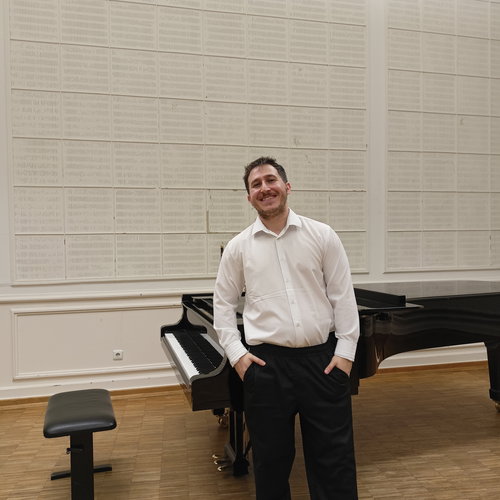
Eyal Urim full profile / Piano / 1 musician
Full program notes
Oliver Messiaen (1908-1992)
Catalogue d'oiseaux (1956-1958)
VI. L'alouette lulu (lullula arborea " The Woodlark”)
“L'Alouette Lulu” is the sixth of thirteen piano pieces from the “Catalogue d'oiseaux.” The composer explains: “Each piece is composed with a specific French region in mind. Its title bears the name of a bird typical of that region. The bird does not appear alone: its fellow birds surround it and sing as well (...); the landscape, which changes with the passing of day and night, is also present, with its colors, its temperatures, and the magic of its scents.”
Johann Sebastian Bach (1685-1750)
Französische Suite Nr. 2 c-Moll BWV 813 (1722-1725)
Allemande
Courante
Sarabande
Air
Menuet I und II
Gigue
The French Suites, BWV 812–817, are a collection of six piano suites. Bach began composing them during his time as Kapellmeister in Köthen around 1722, and they were largely completed by 1725. These works are examples of the Baroque dance suite, with each suite comprising the obligatory dances: Allemande, Courante, Sarabande, and Gigue. Some suites are supplemented by optional dances such as the minuet, gavotte, bourrée, or aria, as is the case with this Second French Suite. Bach likely compiled the French Suites as part of his pedagogical efforts for his students, alongside works such as the Inventions and Sinfonias, and presented them as a wedding gift to his second wife, Anna Magdalena Wilcke. The autograph manuscript is lost; the primary sources are copies made by Bach’s students, including Johann Schneider (1702–1788) and Heinrich Nikolaus Gerber (1702–1775). The title “French Suites” was coined by Heinrich Nikolaus Gerber, who intended to distinguish these cycles from the “English Suites.”
Robert Schumann (1810-1856)
Arabeske op. 18 (1839)
An arabesque is an ornament featuring figurative, floral, or animal motifs used in Arabic art to create complex patterns. It is also a ballet position. Schumann’s Arabesque, Op. 18, can be described as a modified rondo form in which the main theme, the “ritornello,” recurs unchanged a total of three times, interrupted by two distinct “minore” sections. The piece concludes with a contemplative, rather introverted lyrical section titled “Zum Schluss” (In Conclusion). The texture of the ritornello, with its interlacing pattern unfolding between both hands, is reminiscent of a pictorial arabesque; the rondo’s structure, too, can be interpreted as an arabesque form, in which various characters appear alongside a familiar theme. Schumann composed the piece in Vienna, and it was first published in 1839. At that time, Schumann was living apart from Clara Wieck, whose father vehemently opposed their marriage.
Sergej Rachmaninow (1873-1943)
Prélude op. 23. Nr. 1 fis-moll (1901-1903)
Prélude op. 32 Nr. 10 h-moll (1910)
Étude-Tableau ор. 39 Nг. 5 es-Moll (1916/1917)
This first prélude is the first of the “Ten Préludes,” Op. 23, which were composed between 1901 and 1903. Like Chopin, Rachmaninoff also composed 24 Préludes, one in each of the major and minor keys. This Prélude, marked “Largo,” unfolds calmly and is quite introspective, characterized by a steady pulse in the left hand and a melancholic, expansive melody in the right. With the “Thirteen Préludes,” Op. 32, he completed the cycle of twenty-four Préludes he had begun years earlier. The Prélude in B minor illustrates one of Rachmaninoff’s greatest strengths: the construction of a powerful, dense compositional architecture from remarkably simple melodic ideas. This Prélude demonstrates Rachmaninoff’s masterful handling of sonority, as he creates layers of sound that imitate bells, strings, and at times even an entire orchestra. For a piece titled “Prélude,” this work is quite long and marked by intense emotionality. Lastly, Rachmaninoff’s “Études-Tableaux” (“Etudes-Pictures”) combine technical challenges with vivid musical imagery. The nine études, Op. 39, were composed in 1916 during the final years of Tsarist Russia and on the eve of the Russian Revolution. This étude is characterized by a wide range of dynamics and emotions. This piece presents a challenge, as it requires balancing the chordal texture while paying close attention to the various melodies.
Videos from this player

