 Continue with Facebook
 Continue with Google
 Continue with Apple
Three Sonatas, Three Worlds
Details
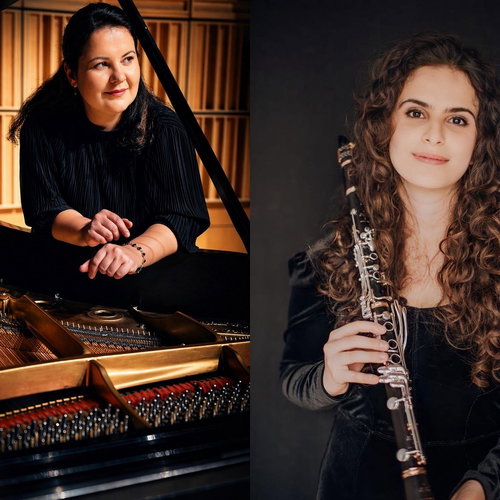
Diana Skobina and Lourd Hadweh full profile / Piano and Clarinet Duo / 2 musicians
Full program notes
Three Sonatas, Three Worlds
Brahms • Poulenc • Bernstein
This program brings together three extraordinary sonatas for clarinet and piano, written in very different musical worlds. We chose these works because they reveal the remarkable versatility of the clarinet—from Brahms’s intimate lyricism to Poulenc’s French elegance and Bernstein’s vibrant American energy.
Johannes Brahms — Clarinet Sonata No. 1 in F minor, Op. 120, No. 1
Written near the end of Brahms’s life, this sonata is deeply intimate and reflective. The clarinet and piano share the music almost as equal voices, moving between warmth, tenderness, passion, and quiet introspection. For us, the work feels less like a traditional “performance” and more like a personal conversation between two musicians.
Francis Poulenc — Clarinet Sonata
Poulenc’s music offers a completely different character—colorful, witty, dramatic, and sometimes unexpectedly melancholic. Written in memory of his friend and fellow composer Arthur Honegger, the sonata moves between playful brilliance and moments of profound lyricism. We love the way Poulenc allows the clarinet to reveal so many different personalities within a single work.
Leonard Bernstein — Clarinet Sonata
Bernstein’s sonata brings the program into the distinctly American musical world of the 20th century. Written in 1941, it combines classical traditions with energetic rhythms, unexpected harmonies, and a strong sense of movement. Its contrasting moods—from lyrical and expressive to rhythmic and exuberant—make it a wonderful conclusion to the program.
Together, these three works take us from Brahms’s Romantic introspection, through Poulenc’s French elegance and wit, to Bernstein’s vibrant American voice. We hope the program feels not only like a journey through different musical traditions, but also like an intimate conversation between clarinet, piano, and audience.
Historical context
The clarinet and piano have been musical partners for more than two centuries, developing from the Classical era into one of the richest chamber-music traditions. This program follows that lineage through three very different musical voices.
Brahms’s Clarinet Sonata No. 1, written in 1894, belongs to the late-Romantic tradition. Brahms was inspired to return to the clarinet after hearing the extraordinary playing of clarinetist Richard Mühlfeld, and his late clarinet works became an important part of the instrument’s repertoire.
Poulenc’s Clarinet Sonata, composed in 1962, represents the distinctive French tradition of the 20th century. Poulenc was a member of Les Six, a group of French composers who sought new musical expressions while maintaining a strong connection to clarity, melody, and French musical character. His sonata was dedicated to the memory of Arthur Honegger.
Bernstein’s Clarinet Sonata, written in 1941, reflects the emerging American musical identity of the 20th century. Bernstein brought together classical traditions with the rhythmic vitality and harmonic language of American music, including influences from jazz.
Together, these works trace a musical journey from European Romanticism through French modernism to the vibrant American sound of the 20th century, showing how the clarinet-and-piano tradition continues to evolve while preserving its intimate spirit of musical dialogue.
Videos from this ensemble


