 Continue with Facebook
 Continue with Google
 Continue with Apple
Biorhythms: Sound as Sanctuary
Details
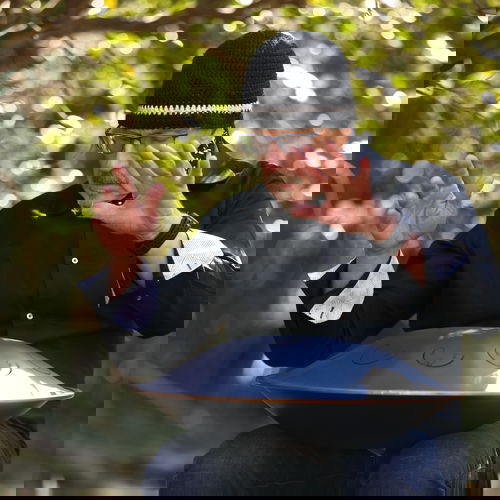
Tom Teasley full profile / hand pans, frame drums, melodica, / 1 musician
Other players: Tom Teasley
Full program notes
Long before there were stages, there were circles.
Before there were genres, there was pulse.
Biorhythms grows out of that older place — the place where rhythm is not entertainment, but orientation. A way of remembering who we are beneath the noise.
The heartbeat is the first drum we hear. Breath is the first phrasing. The body already knows what the mind is trying to rediscover.
In this program, I create an unfolding field of sound using handpan, frame drums, gongs, and small instruments gathered over decades of travel and study. The music is not pre-set. It emerges. It listens back. It responds to the room.
Over the years, my work as a cultural envoy with the U.S. State Department brought me into embassies, conservatories, and community spaces across the Middle East, Asia, Europe, and South America. In every culture, rhythm carried something sacred — whether spoken or unspoken. It created unity without agreement. Presence without explanation.
I have also collaborated with psychotherapists, recording sound environments for guided meditation and presenting at psychotherapy conferences in the United States and Ireland. In those settings, rhythm revealed another dimension — not performance, but alignment. Not spectacle, but integration. The nervous system entrains. The breath deepens. The mind settles.
The handpan rings like a bell suspended in air. The frame drum speaks in ancient syllables — dum, tak, ta — tones that have moved through centuries of ceremony and storytelling. Gongs shimmer and dissolve into silence, and the silence itself becomes part of the composition.
In an intimate space, something subtle happens. The room becomes resonant. Listening becomes active. The boundary between performer and audience softens.
This is not about escape.
It is about return.
Return to pulse.
Return to breath.
Return to the quiet intelligence of rhythm that lives beneath thought.
Some passages are spacious and contemplative. Others build gently, like tides gathering momentum. Stillness and movement are part of the same cycle — inhale and exhale, expansion and release.
Biorhythms is an offering of presence.
We sit together.
We listen deeply.
And something ancient begins to speak.
🙏🪘
Historical context
Long before music became repertoire, it was relationship.
Archaeological evidence suggests that flutes and drums accompanied human gatherings tens of thousands of years ago. These instruments were not created for entertainment. They marked transitions, anchored ceremony, carried story, and aligned communities.
Across cultures, rhythm has served restorative and communicative roles.
In West African traditions, drumming accompanies rites of passage and social cohesion. Frame drums appear in devotional contexts throughout the Middle East and Mediterranean. In South Asian philosophy, nāda describes sound as fundamental vibration — the ground from which experience arises. Monastic traditions across Asia use gongs and bowls to shape silence and focus awareness.
Modern research now speaks of entrainment and nervous system regulation — how steady pulse influences breath, heart rhythm, and attention. What science describes clinically, many cultures have practiced intuitively: repetition organizes the body. Listening reorganizes the mind. Shared rhythm synchronizes community.
My own path into this understanding has moved between formal study and lived experience. Conservatory training provided structure and discipline; apprenticeship with master drummers from India and Africa revealed rhythm as language and lineage.
Later, performing internationally as a cultural envoy, I witnessed how rhythm functions as communication beyond words. In rooms divided by language or history, a shared pulse created immediate common ground. Music became bridge before it became performance.
In therapeutic contexts — recording sound environments for guided meditation and presenting at psychotherapy conferences — I encountered another dimension of this lineage: rhythm as medicine. Not medicine in a clinical sense, but as support. As regulation. As a way of gently bringing scattered attention back into coherence.
Across these settings — conservatory, village, embassy, conference hall, living room — one principle remains consistent:
Sound can carry meaning without speech.
Rhythm can restore orientation without instruction.
The concert tradition often elevates music onto a stage. The older lineage places it in the circle — shared, embodied, relational.
Biorhythms stands within that continuum.
It does not recreate ritual.
It does not claim cure.
It simply explores vibration as communication and presence — a quiet remembering that before music became product, it was medicine for community.
Before genre, before institution, before applause —
there was pulse.
And it still speaks.
Videos from this player


Other programs from this ensemble
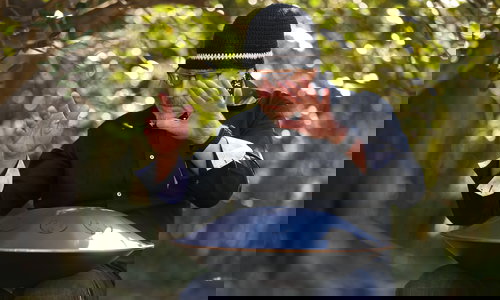
- Musician profile: Tom Teasley
-
 Instruments:
Strings, World Percussion, Hand Pan
Instruments:
Strings, World Percussion, Hand Pan
- Musicians: Tom Teasley, Tom Teasley Chelle Fulk
-
- Musician profile: Tom Teasley
-
Instruments:
World percussion, melodica, hand pan,