 Continue with Facebook
 Continue with Google
 Continue with Apple
Rhythm Without Borders
Details
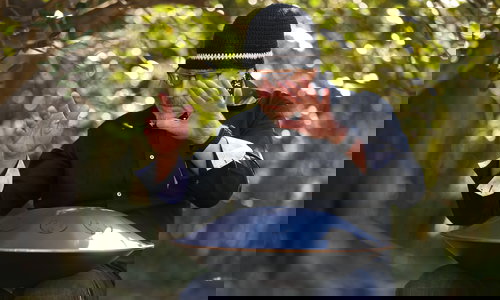
Tom Teasley full profile / World percussion, melodica, hand pan, / 1 musician
Full program notes
Years of classical study, global apprenticeship, theater work, and collaboration across cultures have shaped how I think about rhythm — not as genre, but as relationship.
Rhythm Without Borders brings those influences into a single arc.
The program unfolds across frame drums, multiple tambourines, cajón, darbuka, and subtle electronics used sparingly to extend resonance. Each instrument carries its own history and physical vocabulary.
A central thread of the evening is migration — not of people, but of technique and rhythm. Concepts studied in Indian rhythmic tradition are applied across multiple drums. Structural ideas move from one instrument to another. Rhythmic languages from India, Africa, the Middle East, and jazz coexist within a single evolving framework.
Rather than presenting traditions side by side, the music allows them to interact. A tala-based idea may surface within a Middle Eastern texture. An African-derived pulse may underpin a jazz-inflected improvisation. Techniques are transferred, adapted, and reshaped.
Throughout the evening, I weave brief stories of travel, study, and collaboration into the music — moments from international exchange, apprenticeship with master drummers, and performances across cultures. These reflections provide context, but the primary language remains sound.
Vocal percussion also becomes part of the vocabulary — rhythm carried not only through the hands, but through the voice. Breath, syllable, and pulse intersect, revealing the human origin of every drum.
Unlike Biorhythms, which leans toward stillness and resonance, this program leans into motion. Patterns build and release. Precision meets improvisation. Structure and spontaneity balance one another.
The dynamic range remains intimate. Even at its most kinetic, the music breathes. In a small room, the exchange is direct — listener and performer sharing the same pulse.
Rhythm crosses borders because it is already inside the body.
This program simply makes that visible.
Historical context
The drum is among humanity’s oldest instruments.
Archaeological and textual evidence from ancient Mesopotamia — one of the earliest recorded civilizations — shows frame drums and percussion used in temple ritual, procession, and communal life. Rhythm marked time, reinforced structure, and shaped collective experience.
Across the ancient world, percussion developed in parallel. In Egypt and the Mediterranean, frame drums accompanied ceremony and dance. In West African cultures, layered rhythmic systems emerged that integrated music with social structure. In South Asia, complex tala systems codified rhythm into architecture — mathematical, spiritual, and embodied. Throughout the Middle East, North Africa, and beyond, hand drums became vehicles for improvisation, devotion, and communal gathering.
Though separated by geography, these traditions share fundamental principles:
pulse as orientation,
repetition as structure,
variation as expression.
Over centuries, migration, trade, and collaboration carried these rhythmic languages across borders. African rhythmic systems profoundly shaped the development of jazz in the Americas. Middle Eastern and South Asian percussion traditions entered global concert stages. Western composers began integrating non-Western rhythmic complexity into contemporary music.
Percussion today exists in a uniquely fluid space — grounded in ancient lineage yet open to constant evolution.
For decades, I have lived within this continuum — traveling, studying, recording, and collaborating across traditions. Through apprenticeship with master drummers, conservatory training, theater work, and international exchange, these rhythmic languages have become not separate influences, but components of a single evolving vocabulary.
The result is not historical reconstruction. It is lived synthesis.
Rhythm Without Borders emerges from that lived experience — acknowledging ancient roots while allowing technique, structure, and improvisation to move freely across instruments and cultures.
From early temple drums to contemporary intercultural performance, rhythm has remained both communication and community.
The borders shift.
The pulse endures.
And each generation reshapes it.
Videos from this player


Other programs from this ensemble
- Musician profile: Tom Teasley
-
 Instruments:
Strings, World Percussion, Hand Pan
Instruments:
Strings, World Percussion, Hand Pan
- Musicians: Tom Teasley, Tom Teasley Chelle Fulk
-
Biorhythms: Sound as Sanctuary
- Musician profile: Tom Teasley
-
Instruments:
hand pans, frame drums, melodica,
- Musicians: Tom Teasley, Tom Teasley